





What You Must Know
For every positive experience someone has with the moving industry, someone always has a negative experience. Most negative experiences happen because people are unaware of their responsibilities and rights during moving. Whether you are moving across town or across the country, understanding the laws that protect you is essential to avoiding overcharges, damaged belongings, and disputes that could have been prevented.
When choosing a moving company, ask for a copy of the ‘Moving Advice‘ booklet created by Innovation, Science and Economic Development Canada. It contains a wealth of information, including details on the types of insurance that movers can provide, how to limit a mover’s liability for your belongings, the difference between binding and non-binding estimates, and much more.
Reading the booklet is essential as it will equip you with the necessary knowledge to ensure a smooth and stress-free move.
BC Consumer Protection Laws
In British Columbia, moving companies are regulated under provincial consumer protection legislation. The BC Consumer Protection BC agency oversees fair business practices and can assist when disputes arise with service providers, including movers.
Key protections for BC residents include:
- Written contracts: Movers in BC should provide written agreements that outline the services, estimated costs, and any additional fees before work begins. Verbal agreements are difficult to enforce and leave you unprotected.
- Unfair practices: The Business Practices and Consumer Protection Act prohibits deceptive or unconscionable practices. If a mover misrepresents their pricing, services, or licensing, you have grounds to file a complaint.
- Cooling-off periods: In some circumstances, consumers may have a cooling-off period during which they can cancel a contract without penalty, though this varies depending on how the contract was initiated.
Federal Regulations for Interprovincial Moves
If you are moving between provinces, different rules apply. Interprovincial moves fall under federal jurisdiction, and the Government of Canada provides guidelines through Innovation, Science and Economic Development Canada. Key federal protections include:
- Estimate requirements: Movers must provide written estimates before performing an interprovincial move. These estimates must clearly state whether they are binding, non-binding, or not-to-exceed.
- Payment limits at delivery: For non-binding estimates, you cannot be required to pay more than 110 percent of the estimated cost at the time of delivery. The balance is due within 30 days.
- Bill of lading: The mover must provide a bill of lading, which serves as your receipt and contract. This document should list all items being transported and the agreed-upon terms. Keep this document safe.
Liability Limits and Insurance
Movers typically provide two types of moving insurance: Full Value Protection or Released Value of 60 Cents per Pound per Article. Understanding the difference between these insurances is essential to avoid disputes after the move.
Under released value protection, which is the basic coverage, a mover’s liability is minimal. For example, if a mover damages a laptop weighing 5 pounds, you would only receive about $3.00 in compensation, regardless of the laptop’s actual value. Full value protection provides more comprehensive coverage but comes at an additional cost. Always confirm your coverage level in writing before moving day.
Unfortunately, there have been reports of moving companies overcharging people once the movers arrive. Some of these reasons are legitimate, while others are not. When a moving company prepares an estimate for you, they must inform you of acceptable forms of payment at the drop-off point. You could pay much more than your original estimate if you and your mover operate under a non-binding contract. Therefore, it is crucial to ensure that the agreement and terms you agreed to are binding quotes before anything is done between you and your mover.
Dispute Resolution
If a problem arises during your move, you have several options for resolution:
- Contact the mover directly: Start by filing a written complaint with the moving company. Most reputable movers have a formal claims process and a set timeframe for responding, typically 30 to 90 days.
- File with Consumer Protection BC: For local moves within British Columbia, you can file a complaint with Consumer Protection BC if the mover engaged in unfair or deceptive practices.
- Contact the Canadian Association of Movers: If the mover is a member of the Canadian Association of Movers (CAM), you can file a complaint through their dispute resolution process.
- Small claims court: If informal resolution fails, you can take your case to small claims court. In BC, the Civil Resolution Tribunal handles claims up to $5,000 and is designed to be accessible without a lawyer.
- Better Business Bureau: Filing a complaint with the BBB creates a public record and often motivates companies to resolve issues promptly.
Filing Damage Claims
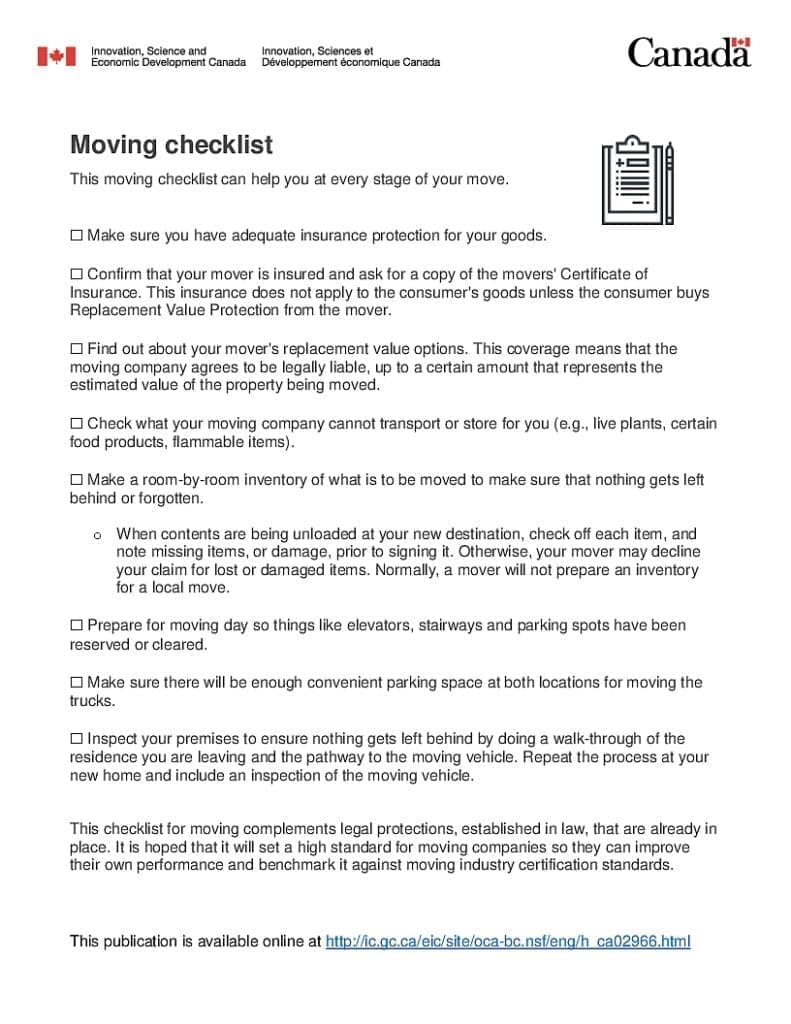
The Canadian Government cannot aid in filing a court injunction against your chosen moving company. However, reviewing the Moving Checklist will reveal a finite window to claim against the said company for any incurred damages or losses during the move. Beyond this period, the company is not obligated to recognize your claim. This time frame is dictated by company policy, not Canadian law.
To strengthen any claim, be sure to:
- Document the condition of your belongings before the move with photos and video.
- Inspect all items at delivery and note any damage on the bill of lading before signing.
- File your written claim within the mover’s stated timeframe, ideally within 7 days of delivery.
- Keep copies of all contracts, estimates, receipts, and correspondence.
Documents to Keep
Throughout your move, maintain a file with the following documents:
- Written estimate (binding, non-binding, or not-to-exceed)
- Signed contract or agreement
- Bill of lading
- Inventory list
- Proof of insurance coverage
- Photos and video of belongings before and after the move
- All receipts and payment records
- Any email or written correspondence with the mover
Before You Move
Read the Moving Advice website created by the Government of Canada. It outlines consumers’ and moving companies’ rights and responsibilities and other essential advice not mentioned in the checklist below.
Knowing your rights is the single most effective way to protect yourself during a move. If you have questions about your upcoming move or want to work with a mover who values transparency, contact Simple Moves for a free consultation.
Consumer Protection Laws for Moving in Canada (2026)
As a consumer hiring a moving company in Canada, you are protected by both federal and provincial consumer protection legislation. In British Columbia, the Business Practices and Consumer Protection Act governs transactions between consumers and businesses, including moving services. This legislation prohibits deceptive practices, requires transparent pricing, and provides remedies when companies fail to meet their obligations.
Moving companies operating in BC must honour their written estimates and contracts. If a company provides a binding estimate, they cannot charge more than the agreed amount for the services outlined. If they provide a non-binding estimate, the final charge should be reasonably close to the estimate — a significant overcharge without justification may constitute a deceptive business practice under provincial law.
Your Right to a Written Estimate and Contract
Before your move begins, you have the right to receive a detailed written estimate that breaks down all charges. This estimate should specify the hourly rate or flat fee, the crew size, the truck size, any additional services (packing, stair charges, long carries), and the estimated total cost. Reputable full-service movers provide this documentation as standard practice.
You also have the right to a written contract that outlines the terms of service, including pickup and delivery dates or windows, liability coverage, the claims process for damaged items, cancellation policies, and payment terms. Never agree to a move based solely on a verbal agreement. A written contract protects both you and the moving company and provides clear recourse if issues arise.
Your Rights During the Move
During the actual move, you have the right to supervise and direct the crew regarding how items should be handled and placed. You can ask movers to use furniture pads, take extra care with specific items, and place belongings in designated rooms or locations. The crew should follow your reasonable instructions without pushback.
You also have the right to refuse service if the company sends a smaller crew than agreed upon, sends a truck that is clearly too small for your belongings, or shows up significantly late without communication. If the moving company fails to provide the service as contracted, document the discrepancy immediately and contact the company’s management before allowing the move to proceed. This documentation strengthens your position if a dispute arises later.
Your Rights After Delivery and During Claims
Upon delivery, you have the right to inspect every item before signing the final delivery receipt. Take your time — do not let the crew pressure you into signing quickly. Note any damage, missing items, or discrepancies directly on the delivery receipt. Once you sign without noting exceptions, your ability to file certain claims may be limited.
If items are damaged or missing, you have the right to file a claim with the moving company within the timeframe specified in your contract. The company is required to respond to your claim within a reasonable period and provide either compensation, repair, or replacement as outlined in their liability terms. If the company refuses to address your claim, you can escalate to the Better Business Bureau, your provincial consumer protection office, or small claims court for amounts within the court’s jurisdiction.
What Moving Companies Cannot Legally Do
Moving companies in Canada cannot hold your belongings hostage for payment that exceeds the original binding estimate. This practice, while unfortunately not unheard of, is illegal. If a company threatens to not unload your belongings unless you pay inflated charges, document the threat and contact local police as well as your provincial consumer protection authority.
Companies also cannot add undisclosed fees that were not part of the original estimate without your written consent, make false claims about insurance coverage, refuse to honour the terms of a signed contract, or misrepresent their credentials, experience, or affiliations. If you encounter any of these practices, choosing a reputable company with verifiable reviews and transparent pricing from the start is the best prevention.
Frequently Asked Questions About Moving Rights in Canada
What should I do if movers damage my property?
Document the damage immediately with photographs and written notes. Note it on the delivery receipt. File a written claim with the moving company within the contract’s specified timeframe. If the company does not respond satisfactorily, escalate to your provincial consumer protection agency or small claims court.
Can a moving company charge me more than the written estimate?
For a binding estimate, no — they must honour the quoted price for the agreed services. For a non-binding estimate, the final charge may differ, but significant overcharges without justification may violate consumer protection laws. Always request a binding or not-to-exceed estimate when possible.
What if the moving company cancels on my moving day?
A last-minute cancellation by the mover may constitute a breach of contract. Document everything, including any additional costs you incur by hiring a replacement company or rescheduling. You may be entitled to recover those additional costs through small claims court or consumer protection channels.
Do I have to pay before my belongings are unloaded?
Payment terms are outlined in your contract. Some companies require payment upon delivery, while others invoice after the move. However, a company cannot demand payment significantly exceeding the estimate as a condition of unloading your belongings.
Know your rights and choose movers who respect them. Simple Moves operates with full transparency, written contracts, and fair pricing on every full-service move. Call (604) 398-4680 or get your free quote today.
Get a Free Moving Quote From Simple Moves
Simple Moves is a full-service moving company serving Metro Vancouver, the Fraser Valley, and all of British Columbia. We provide the experienced movers and the trucks — you do not need to rent a vehicle or recruit friends. Whether you are moving across the street or across the province, we make every move simple.
Call (604) 398-4680 or request a free quote online today.