


Moving house is always going to take a bit of effort. Dealing with years of accumulated belongings and sorting through everything is sure to cause a headache. There is a reason why moving is regularly said to rank as one of the most stressful activities a human can do.
Updated for 2026 — this guide reflects the latest moving tips and pricing for the Greater Vancouver area.
Table of Contents
- Plan Before You Lift
- Remove Everything You Can First
- Essential Tools and Equipment for Heavy Lifting
- Proper Lifting Technique
- How to Move Specific Heavy Items
- Protect Your Home During the Move
- When to Call Professional Movers
- Loading Heavy Items onto the Truck
- Common Mistakes When Moving Heavy Items
- The Weight of Common Household Items
Do not worry, though — there are plenty of moving tips and tricks to help make your move as easy as it can be. In this guide from Simple Moves & Storage, we are going to cover the best ways to move bulky, heavy, and awkward items safely — whether you are tackling a full house move or just rearranging a single room. Let us get started.
Plan Before You Lift
The biggest mistake people make with heavy items is trying to move them without a plan. Before you touch anything, take these preliminary steps:
- Measure doorways, hallways, and staircases: Know the exact dimensions of every passage the item needs to pass through. A sofa that fits through a 36-inch door at one angle may not clear a 32-inch hallway around the corner.
- Map your route: Walk the path from the item’s current location to the truck (or its new spot) without carrying anything. Identify tight turns, steps, uneven surfaces, and any obstacles that need to be moved first.
- Clear the path completely: Remove rugs, shoes, plants, and any other trip hazards. Open all doors along the route and prop them in place. If you are moving through a condo building, book the service elevator in advance.
- Recruit enough help: A general rule is that any item over 100 pounds should be moved by at least two people, and items over 200 pounds (like a piano or safe) require three or more trained movers with proper equipment.
Remove Everything You Can First
Before attempting to move a large piece of furniture, strip it down to its lightest possible state:
- Drawers: Remove all drawers from dressers, filing cabinets, and desks. Pack the drawer contents separately and carry the drawers individually — they are surprisingly heavy when loaded.
- Shelves: Remove adjustable shelves from bookshelves and cabinets. Wrap glass shelves in bubble wrap or moving blankets.
- Legs and feet: Many sofas, tables, and bed frames have removable legs. Taking them off reduces both weight and width, making it easier to navigate through doorways.
- Cushions and bedding: Strip mattresses, remove sofa cushions, and take off any detachable fabric covers. Pack these separately in bags.
- Hardware: Put all screws, bolts, and small hardware in labelled zip-lock bags and tape them to the furniture piece they belong to.
Essential Tools and Equipment for Heavy Lifting
Professional movers never rely on brute strength alone. The right equipment makes heavy items manageable and dramatically reduces the risk of injury or damage:
Furniture Dolly
A flat, four-wheeled platform dolly is ideal for heavy, flat-bottomed items like dressers, appliances, and stacked boxes. Place the item on the dolly, strap it down, and roll it along flat surfaces. Cost to rent: approximately $15 to $25 per day.
Appliance Hand Truck (Two-Wheeler)
The classic L-shaped hand truck is essential for moving refrigerators, washing machines, and other tall, heavy appliances. Tilt the item back onto the hand truck’s lip, strap it securely, and use the leverage of the handle to roll it. Many hand trucks have stair-climbing wheels that make it possible to bump items up or down steps safely.
Furniture Sliders
These small pads — felt on one side, plastic on the other — slide under furniture legs and allow you to glide heavy items across hardwood, tile, or carpet with minimal effort. They are inexpensive (under $10 for a set) and save your floors from scratches.
Moving Straps (Forearm Forklift)
Lifting straps loop under a heavy item and distribute the weight across your forearms or shoulders instead of your hands and lower back. Two people wearing lifting straps can carry a washing machine or heavy dresser up a flight of stairs with significantly less strain.
Moving Blankets and Stretch Wrap
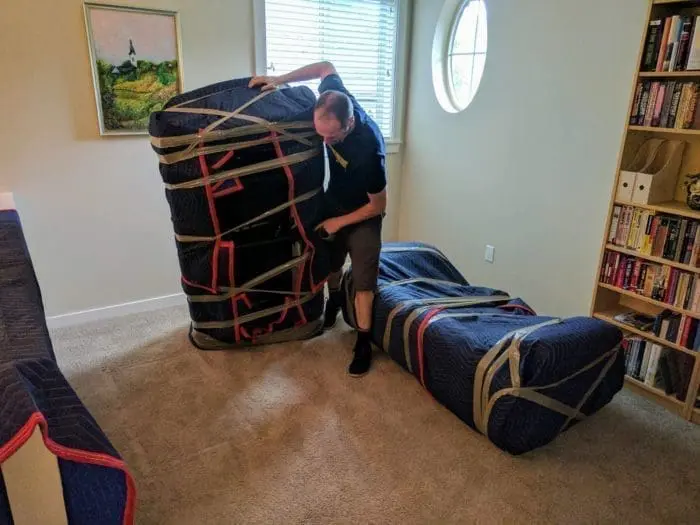
These are not lifting tools, but they are essential for protecting both your items and your home. Wrap furniture in moving blankets before transport, and use stretch wrap to keep blankets, drawers, and doors secured in place.
Proper Lifting Technique
Even with the right tools, you will need to lift at some point. Protect your body with proper form:
- Stand close to the item with your feet shoulder-width apart.
- Bend at your knees and hips, not your waist. Keep your back straight and your core engaged.
- Grip firmly with both hands. If the item does not have handles, grip the bottom edge or use lifting straps.
- Lift with your legs by straightening your knees. Your leg muscles are far stronger than your back muscles.
- Keep the item close to your body throughout the carry. The farther an item is from your centre of gravity, the more strain it places on your back.
- Pivot with your feet, never twist your torso while holding a heavy load.
- Set down by reversing the process: bend at the knees and hips, lower slowly, and place the item gently.
Warning signs to stop immediately: sharp pain in the back, tingling or numbness in the arms or legs, dizziness, or loss of grip strength. Put the item down and reassess your approach.
How to Move Specific Heavy Items
Refrigerators and Freezers
Empty all contents, unplug at least 24 hours before moving (to allow the compressor oil to settle), remove doors if needed, and use an appliance hand truck. Keep upright during transport — laying a fridge on its side can damage the cooling system.
Washing Machines and Dryers
Disconnect water supply lines and power cords. For front-load washers, use transit bolts (they came with the machine) to lock the drum. Tape the door shut and use an appliance dolly.
Sofas and Sectionals
Remove legs, cushions, and any sleeper-sofa mattress. Tilt the sofa on its end to fit through narrow doorways — most standard sofas fit through a 30-inch doorway when turned vertically. Wrap in moving blankets to protect fabric and walls.
Dressers and Armoires
Remove all drawers and hardware. Wrap the frame in moving blankets. Use a dolly for transport. If the piece is exceptionally tall, have one person stabilize the top while the other guides the dolly.
Pianos
Pianos are among the most difficult items to move due to their extreme weight (300 to 1,200 pounds) and delicate internal components. We strongly recommend hiring professional piano movers. Simple Moves has specialized equipment and trained crews for piano relocations.
Protect Your Home During the Move
Heavy items do not just risk damage to themselves — they can wreck your floors, walls, and doorframes. Here is how to protect your home:
- Door frames: Cover edges with foam padding or old towels secured with painter’s tape.
- Floors: Lay down cardboard runners or Ram Board along the moving path. Use furniture sliders on hardwood.
- Walls and corners: Place corner guards on exposed wall corners along the route.
- Banisters and railings: Wrap with moving blankets or pool noodles.
- Elevators: Most condo buildings require elevator padding for move days — check with your building manager.
When to Call Professional Movers
There is a point where DIY moving becomes impractical, unsafe, or more expensive than hiring professionals. Consider calling Simple Moves & Storage if:
- You have more than two or three items over 100 pounds
- Your home has stairs, tight hallways, or no elevator access
- You are moving specialty items (pianos, hot tubs, safes, pool tables)
- You have a tight timeline and cannot afford delays from injuries or damage
- You want insurance coverage for your belongings during transport
As a full service moving company, Simple Moves provides the crew and the trucks. Our teams move heavy and bulky items every day — we have the equipment, the training, and the insurance to do it safely and efficiently.
Loading Heavy Items onto the Truck
Getting heavy items into the moving truck safely is just as important as moving them out of your home. Follow these guidelines:
- Use the ramp: Professional moving trucks come with built-in ramps or liftgates. If you are renting a truck, make sure it has a ramp — carrying a 200-pound dresser up a step without one is dangerous and unnecessary.
- Load heavy items first: Place the heaviest items — appliances, safes, heavy furniture — at the front of the truck (closest to the cab) and on the bottom. This keeps the truck’s centre of gravity low and prevents lighter items from being crushed.
- Secure everything with straps: Use ratchet straps or rope to secure heavy items to the truck’s anchor points. Items that shift during transport can topple, break, and create dangerous conditions when you open the truck doors at the other end.
- Fill gaps with soft items: Use mattresses, sofa cushions, and bags of clothing to fill spaces between heavy items. This prevents shifting and provides additional cushioning.
- Distribute weight evenly: Do not load all the heavy items on one side of the truck. An unbalanced load affects the truck’s handling, especially during turns and braking.
Common Mistakes When Moving Heavy Items
Even well-intentioned movers make these errors. Avoid them to prevent injury and damage:
- Lifting with your back: The most common and most dangerous mistake. Always lift with your legs, keeping your back straight and core engaged.
- Rushing: Heavy items demand slow, deliberate movements. Rushing leads to dropped items, strained muscles, and damaged walls. Take your time, especially on stairs and around corners.
- Not communicating: When two or more people carry a heavy item, one person should be the designated leader, calling out directions: “step down,” “turning left,” “set it down.” Without clear communication, one person may step forward while the other stops, causing the item to twist or fall.
- Wearing the wrong footwear: Flip-flops, sandals, and smooth-soled shoes have no place on a moving day. Wear closed-toe shoes with good traction — steel-toed boots are ideal for very heavy items.
- Ignoring pain: If something hurts, stop. A minor twinge that you work through can become a serious injury within minutes. Set the item down, stretch, and reassess.
- Overestimating your abilities: There is no shame in admitting that an item is too heavy or awkward for you and your helpers. It is far better to call a professional than to end up in the emergency room.
The Weight of Common Household Items
Knowing approximate weights helps you plan your approach and recruit the right amount of help:
| Item | Approximate Weight | Recommended Approach |
|---|---|---|
| King-size mattress | 60–100 lbs | Two people, carry on edge |
| Large dresser (empty) | 100–150 lbs | Two people with dolly |
| Refrigerator | 200–350 lbs | Appliance hand truck, two people |
| Washing machine | 150–200 lbs | Appliance hand truck, two people |
| Upright piano | 300–500 lbs | Professional movers required |
| Grand piano | 500–1,200 lbs | Specialty piano movers required |
| Hot tub (empty) | 400–900 lbs | Professional movers with crane/equipment |
| Pool table (slate) | 700–1,000 lbs | Must be disassembled, professional movers |
| Three-seat sofa | 100–200 lbs | Two people, remove legs if needed |
| Solid wood dining table | 80–200 lbs | Remove legs, two people |
Ready to Make Your Move Simple?
Simple Moves & Storage is a full service moving company serving the Greater Vancouver area and all of BC. We provide the labour and the trucks — you just tell us where to go.
Call us today at (604) 398-4680 or get a free moving quote online.